
If you are considering microcement for a bathroom, floor, wall or commercial interior, one of the first questions is usually:
How much does microcement cost?
The frustrating answer is that there is no single price per square metre that accurately applies to every microcement project.
As a broad 2026 London budgeting guide, professionally installed microcement can range from around £100 per m² to £200+ per m², with some large, straightforward areas costing less per square metre and small or technically demanding installations costing considerably more.
Bathrooms, wet rooms, staircases, niches and highly detailed surfaces usually have a higher effective price per m² than a large open floor because significantly more labour is required within a relatively small area.
For example, at 3D Royal Floors, a large standard microcement floor of 100m² or more on a good-quality substrate may start at approximately £110–£115 per m² + VAT, depending on specification and project conditions. Smaller floors and more complex projects are priced individually.
This is why we prefer to assess each project rather than advertise one headline rate that may bear little relation to the final cost.
At 3D Royal Floors, we have more than 15 years’ experience working with seamless decorative finishes across residential and commercial environments in London. Our projects range from individual bathrooms and feature surfaces to commercial areas measuring hundreds or even thousands of square metres.
In this guide, we explain what you should realistically budget for microcement in London in 2026, what makes one project more expensive than another and what you should look for when comparing quotations.
Microcement Cost in London: Quick 2026 Guide
The figures below should be treated as budgeting guidance rather than fixed 3D Royal Floors prices.
Every project needs to be assessed individually because the condition of the existing substrate, preparation required, project size, waterproofing specification and complexity of the installation can substantially change the cost.
| Microcement Application | Indicative 2026 Budget |
|---|---|
| Large open floors of 100m²+ on a suitable substrate | From approximately £95–£115/m² + VAT |
| Residential microcement floors | Approximately £120–£200+/m² |
| Microcement walls | Approximately £100–£180+/m² |
| Bathroom & wet-area surfaces | Approximately £140–£220+/m² |
| Stairs and highly detailed surfaces | Normally priced individually |
| Large commercial installations | Project-specific; economies of scale may reduce the effective m² rate |
Published 2026 London and South East pricing varies considerably between installers because different companies include different levels of substrate preparation, reinforcement, waterproofing and finishing within their quoted rates.
For that reason, the cheapest price per m² is not necessarily the cheapest completed project.
What Does Microcement Cost per m² in the UK?
One of the most searched questions is “how much does microcement cost per m² in the UK?” The difficulty is that microcement is not simply a material that is rolled onto a prepared floor.
A professional installation may require:
- floor area
- screed condition
- cracks or movement
- moisture levels
- existing tiles or coatings
- required levelling
- reinforcement requirements
- number of rooms
- stairs or level changes
- chosen texture
- chosen protective coating
- site access
- project program
A photograph and approximate dimensions can often give us an initial idea, but a detailed quotation should always consider the substrate.
How Much Does a Microcement Floor Cost?
Large, relatively open floors are usually among the most efficient applications of microcement.
A 100m² open-plan commercial or residential area generally has far fewer corners and difficult details than the equivalent surface area split between several bathrooms, staircases and small rooms.
At 3D Royal Floors, our current guide for a standard grey microcement finish over a suitable substrate on areas of 100m² or more is approximately £95–£115 per m² + VAT, subject to the final project specification.
You can learn more about our residential microcement flooring and commercial microcement flooring.
Smaller residential floors generally have a higher cost per square metre because the same mobilisation, preparation, masking, mixing and multi-stage application process is spread over fewer metres.
Factors affecting microcement floor cost include:
- assessment of the existing substrate
- repairs and levelling
- reinforcement where required
- appropriate primer
- scratch or base coats
- multiple microcement layers
- sanding between stages
- pre-sealing
- polyurethane or other appropriate protective top coats
- waterproofing preparation in wet areas
- careful finishing around corners, edges, drains and fittings
Labour and surface preparation can therefore account for a substantial proportion of the final cost.
Two rooms measuring exactly 20m² can require completely different amounts of work. One might be ready to prime and coat. The other might contain cracked screed, loose tiles, old adhesive, different substrates and movement joints that need addressing before microcement can safely be applied.
That is why experienced microcement installers in London should assess the surface as well as the square meterage.
How Much Do Microcement Walls Cost?
Microcement can be applied to feature walls, bathrooms, kitchens, hallways, commercial walls and many other vertical surfaces.
Typical London market rates for straightforward wall applications can be around £100–£180+ per m², although small walls or complex surfaces may cost considerably more per square metre.
The main difference is often preparation.
A flat, stable plasterboard wall is very different from an old tiled bathroom wall containing multiple corners, pipes, niches and damaged sections.
Our microcement wall finishes can be used to create a continuous decorative surface with a wide range of colours and textures.
Again, we recommend comparing the scope of preparation and complete system, not simply the final price per metre.
How Much Does a Microcement Bathroom Cost in London?
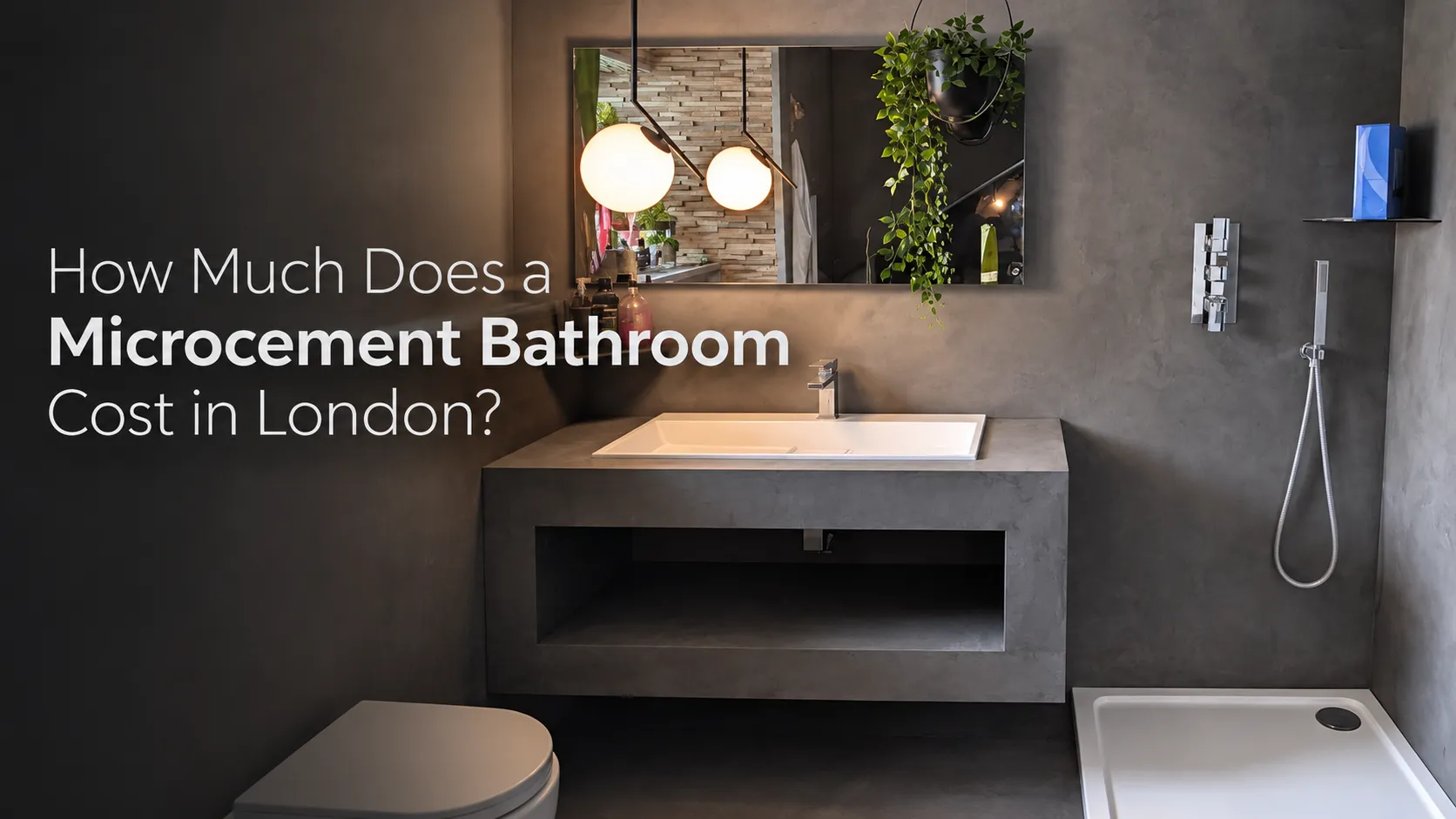
Bathrooms are one of the most popular applications for microcement — and also one of the hardest areas to price accurately per square metre.
Why?
Because bathrooms are normally small but contain a large number of details.
A microcement bathroom may involve:
- floors
- several walls
- bath surrounds
- shower areas
- niches
- internal and external corners
- vanity units
- boxing
- drainage areas
- pipe penetrations
- waterproof zones
- sanitary ware junctions
A bathroom with a floor measuring only 5m² may have several times that amount of actual wall and floor surface requiring microcement.
This distinction is very important when comparing online prices.
When someone advertises a “5m² bathroom”, they may be referring to 5m² of floor area, not 5m² of microcement application.
For a professionally installed microcement bathroom in London, a useful surface-rate budgeting range can be approximately £140–£220+ per m², but the total bathroom project cost depends heavily on what needs to happen before the decorative finish begins.
For inspiration and more technical information, see our dedicated microcement bathroom surfaces service.
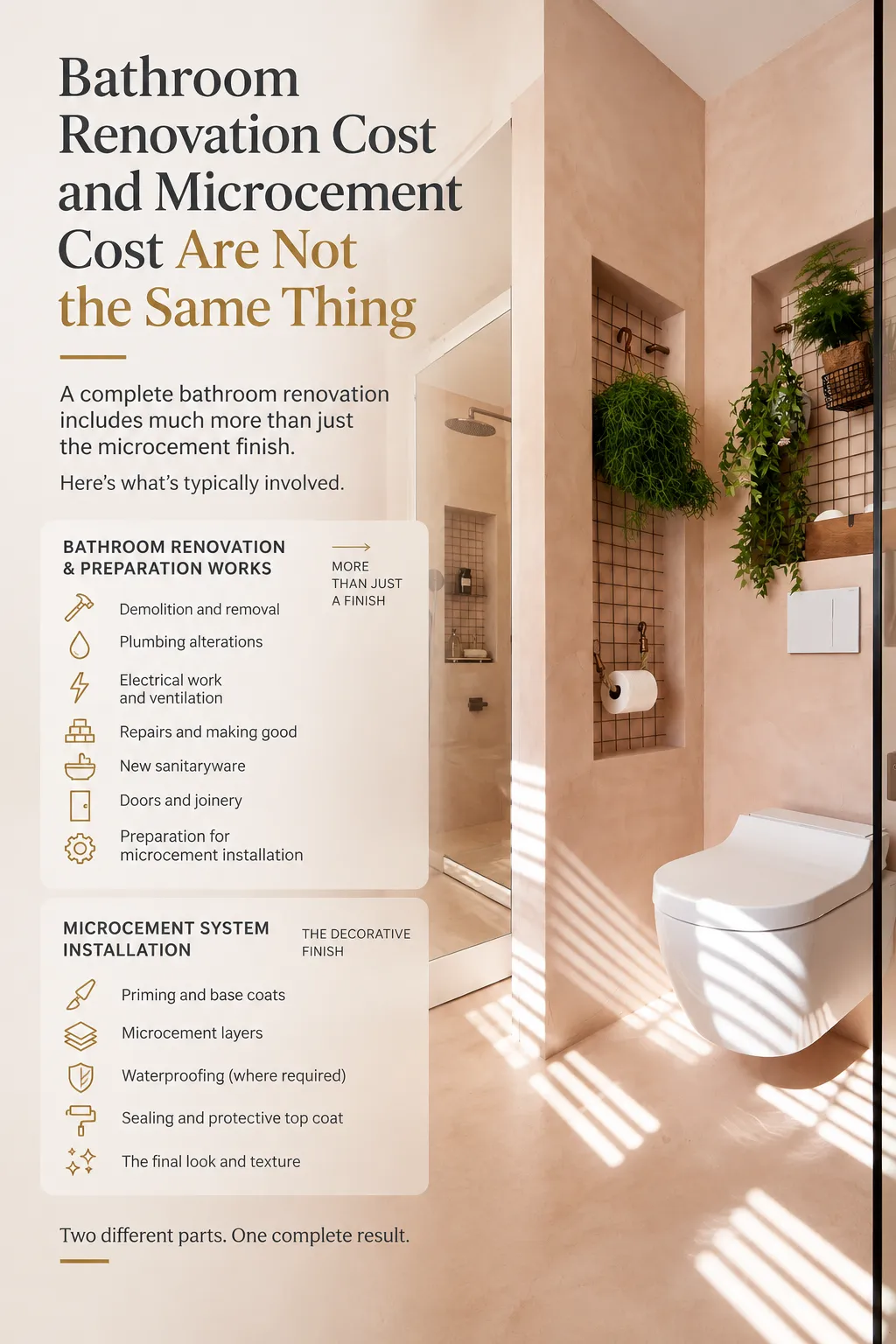
Bathroom Renovation Cost and Microcement Cost Are Not the Same Thing
A quotation for a complete bathroom renovation with microcement can include two very different categories of work:
These should not be confused.
A client may see a £7,000 bathroom quote from one company and a £4,000 “microcement bathroom” quote from another, but one may include extensive renovation work while the other covers only the decorative microcement application.
Always compare scope with scope.
Real 2026 Microcement Bathroom Quotation Example
To make this clearer, here is an anonymised example from a genuine 3D Royal Floors quotation prepared for a London bathroom project in 2026.

Every bathroom is different, so this example should not be treated as the expected cost of another project. It simply demonstrates how preparation and microcement installation can be separated within a professional quotation. The client requested a full bathroom renovation, not just microcement installation.
Item 1 – General Bathroom Renovation & Preparation Works
The project required substantial preparation and renovation work before the final microcement installation, including:
- removal of the existing bath screen
- removal of the bath
- removal of the toilet
- removal of the sink
- removal of the towel rail
- alterations to shower pipework
- installation and connection of a new bath
- installation of bath panel
- resealing and making good around pipe channels and bath
- relocation of the bathroom light switch
- electrical preparation for a new extractor fan
- forming wall openings and installing an extractor fan with overrun timer
- creating boxing to conceal the extractor duct
- making good walls and ceiling
- fitting a replacement towel rail
- fitting a new vanity unit, sink and tap
- replacing the light above the basin
- fitting the new toilet
- replacing the existing bathroom door with a bi-fold door
- installing the bath screen
Labour, including first-fix materials: £3,955.00 ex VAT
Item 2 – Supply & Installation of Microcement System
The microcement specification included:
- primer / scratch coat
- 2–3 microcement coats as required
- microcement pre-seal
- polyurethane protective top coat
- satin-matt finish
Microcement system supply and installation: £3,720.00 ex VAT
Total Project Price
£7,675.00 ex VAT
The important point is that only £3,720 of the £7,675 quotation related to the microcement system itself.
The remaining amount covered the extensive renovation and preparation work required to bring the bathroom to the point where the final surface could be installed.
Why Does a 10m² Bathroom Cost More per m² Than a 150m² Open Floor?
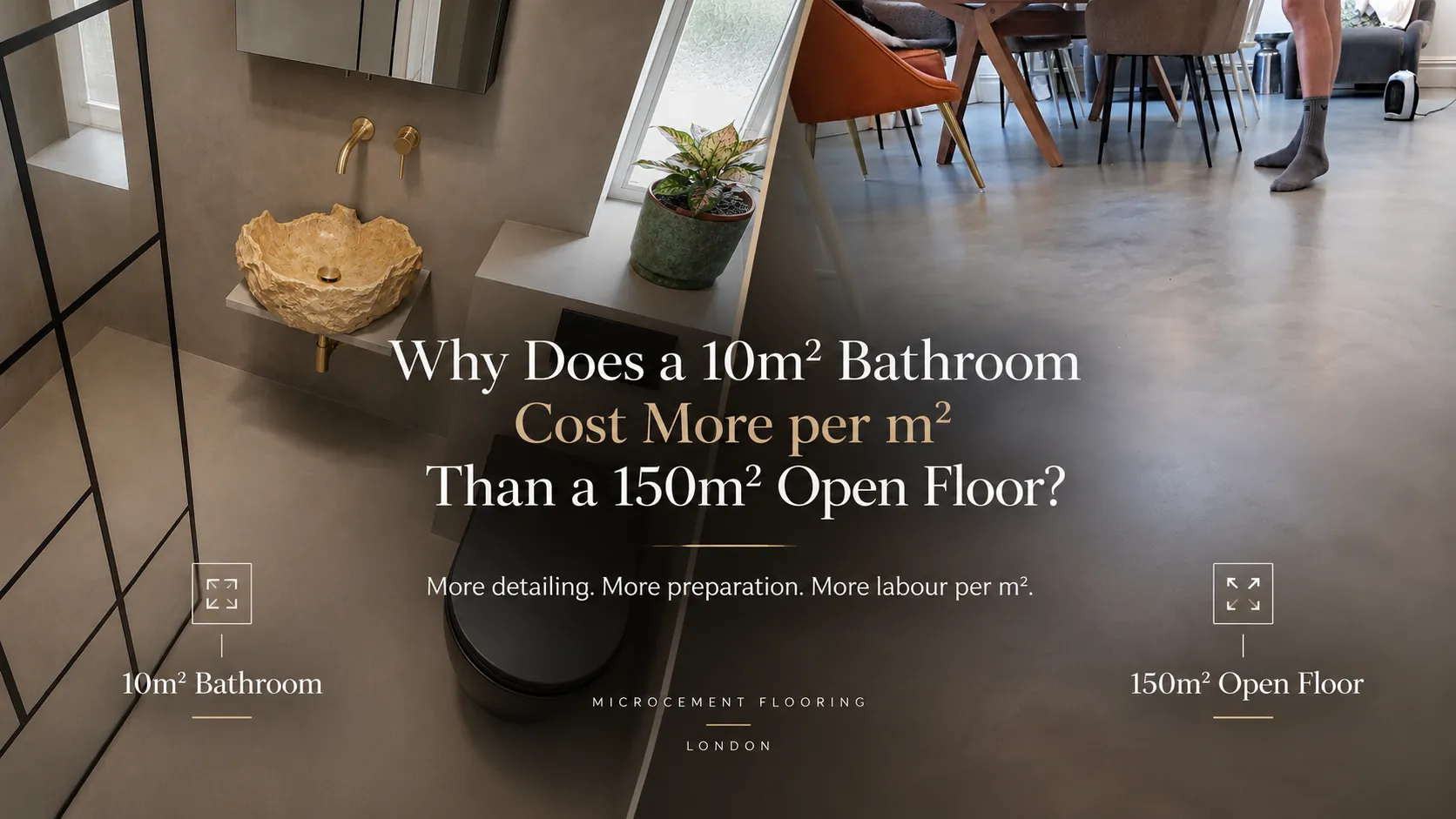
This is one of the most useful ways to understand microcement pricing.
Imagine two projects:
Project A: 150m² open commercial floor.
Project B: small bathroom containing several walls, a floor, bath, shower niche, vanity unit, pipe penetrations and multiple internal and external corners.
Although Project A is much larger, installers can work efficiently across a continuous area.
Project B requires far more detailed hand work.
Every corner must be finished carefully. Every junction requires attention. Fixtures must be protected. Small surfaces may need to be approached from different angles and wet areas may require additional preparation.
There are also fixed project costs that exist whether we install 8m² or 100m²:
- site mobilisation
- tools and equipment
- protection
- masking
- material preparation
- cleaning
- travel
- several separate installation visits while layers cure
On a large project, these costs are distributed across many square metres. On a tiny project, they are distributed across very few.
This is why a microcement price per m² becomes progressively less useful as projects become smaller or more complicated.
What Should a Professional Microcement Quotation Include?
When comparing microcement companies in London, don’t only compare the final total. Look carefully at what the quotation actually includes.
A professional proposal should make it reasonably clear what preparation and finish are being allowed for.
Depending on the project, look for information relating to:
Surface Preparation: One of the Biggest Factors in Microcement Cost
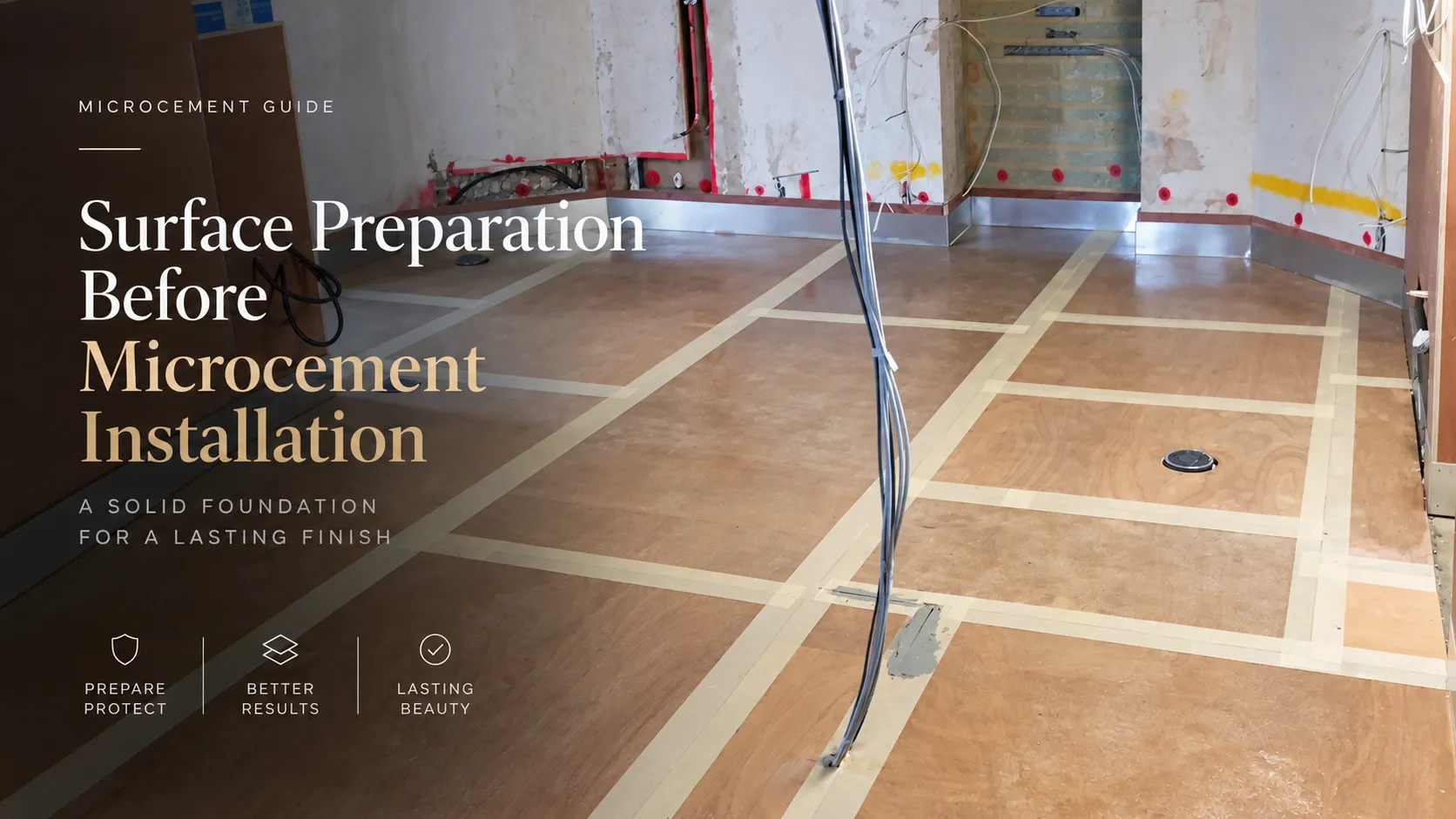
The finished microcement may only be a few millimetres thick, but what is underneath it matters enormously.
Microcement is a decorative finish — it does not make an unstable substrate structurally sound.
Before installation, we may need to consider:
- cracks
- loose tiles
- damaged screed
- uneven surfaces
- moisture
- movement between materials
- weak substrates
- poorly constructed boxing
- unsuitable boards
- existing coatings or adhesives
- floor levels
A low quotation based on applying microcement immediately over a problematic substrate can become expensive if the finish subsequently fails. Preparation is therefore not an inconvenience that should automatically be removed from a quotation to save money.
It is part of producing a reliable finished surface. If the installer is advising that the microcement cannot be laid on your substrate, it’s better to take his view into consideration.
Can Microcement Be Applied Over Existing Tiles?

Often, yes — provided the existing tiled surface is suitable.
One of microcement’s major renovation advantages is that it can sometimes be installed without removing the existing tiles.
That can potentially reduce:
- demolition
- waste
- skip costs
- dust
- project duration
- damage to surrounding areas
However, this does not mean that microcement should simply be applied straight over every tiled surface.
Existing tiles need to be checked for stability and defects. Grout lines, transitions and surface levels will require preparation before the decorative system begins. If tiles are loose, unstable or hiding a problem underneath, removal may still be the correct solution.
We are preparing a separate detailed guide on microcement over tiles, because this deserves much more explanation than a single section.
Why Corners, Niches and Stairs Increase Microcement Cost
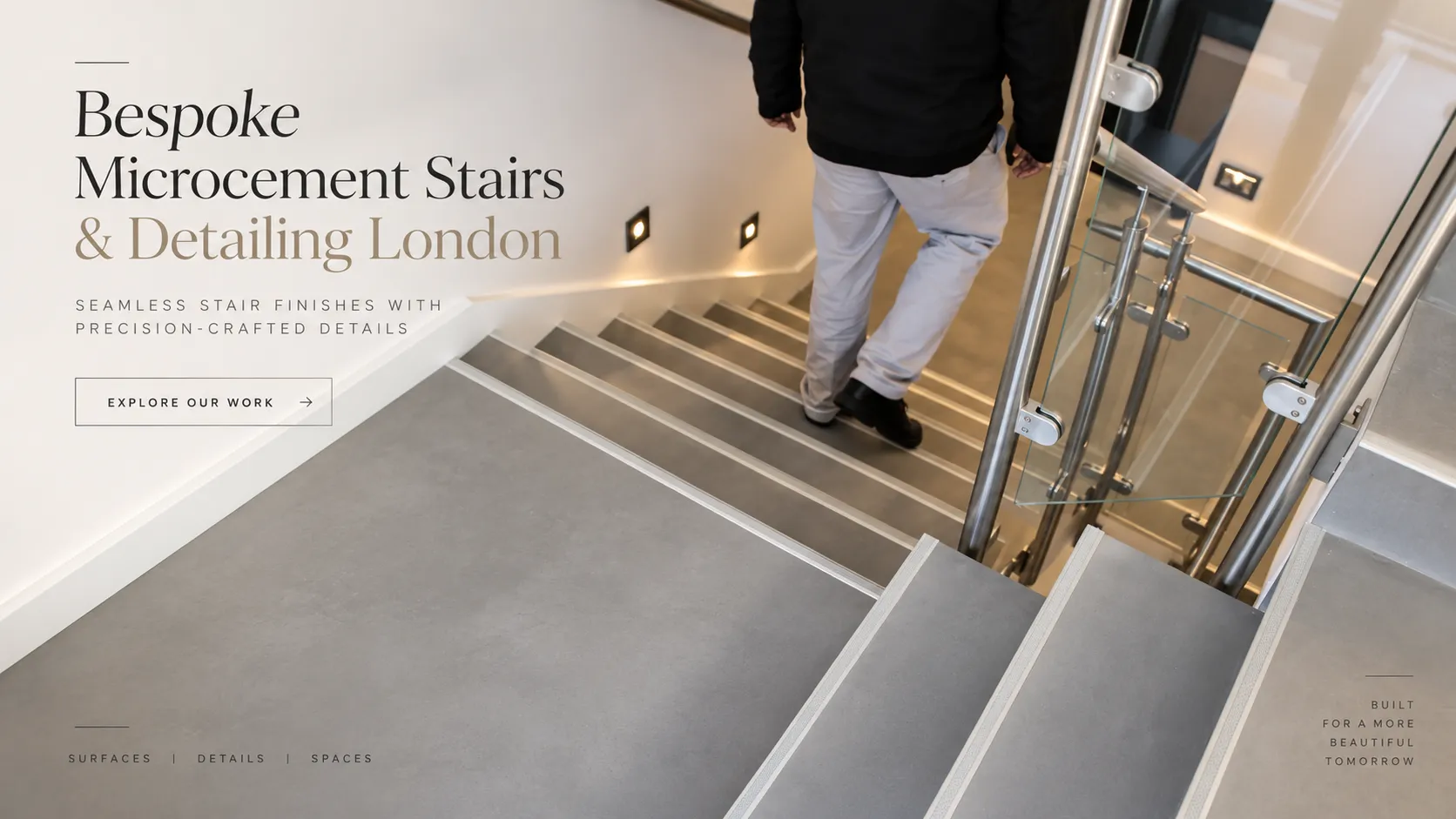
Microcement is hand applied. The more details an installer has to form and finish, the more labour the project generally requires.
A straight 30m² floor is relatively efficient.
Thirty square metres spread across:
- stair treads
- risers
- stringers
- niches
- shelves
- curved walls
- vanity units
- window reveals
is an entirely different project.
Microcement Stairs
Stairs are particularly labour intensive because every tread, riser, edge and return needs individual attention.
For this reason, we normally recommend pricing a microcement staircase as a project or by the individual staircase specification, rather than relying on an average square-metre rate.
The same principle applies to bespoke furniture and architectural details.
Waterproofing and Sealing: Why Bathrooms Can Cost More
Bathrooms, showers and wet rooms require greater consideration than a dry decorative wall. The exact system will depend on the selected microcement product and how the bathroom has been constructed, but professional installation needs to consider:
- the underlying wet-area construction
- junctions and corners
- penetrations
- shower areas
- falls toward drains
- water exposure
- appropriate primers
- appropriate protective coats
- slip resistance where required
These stages take time.
That is one reason why a small microcement shower or wet room can have a higher price per square metre than a large dry wall or open floor. Trying to save money by reducing the correct preparation or protective system in a constantly wet area is rarely good value.
Does London Location Affect Microcement Installation Cost?
Sometimes.
The microcement itself does not become more expensive because the property is in Chelsea rather than Wimbledon. But the logistics surrounding a London project can affect the amount of labour and organisation required.
Examples include:
- restricted parking
- congestion
- loading restrictions
- permits
- apartment access
- several flights of stairs
- small lifts
- protection of communal areas
- limited working hours
- building-management requirements
- restricted delivery times
A ground-floor property with parking directly outside is simply easier to work in than a high-floor Central London apartment with controlled access. For larger commercial projects, access and programme restrictions can be particularly important.
3D Royal Floors works throughout London on both residential microcement projects and commercial microcement installations.
Is Microcement Cheaper Than Tiles?
Sometimes — but not always.
Microcement and tiling should not be compared simply by looking at the cost of a box of tiles and the cost of a microcement system. The real comparison is the complete installed project. For a tiled renovation you may need to consider:
- removal of existing tiles
- disposal
- repairs to the substrate
- new tiles
- adhesive
- grout
- trims
- tile installation
- sealing where applicable
Microcement can sometimes be applied over an existing stable surface, potentially avoiding part of the demolition process. On the other hand, inexpensive tiles installed onto a brand-new, perfectly prepared surface may cost less than a specialist microcement installation.
The decision should therefore consider more than the initial price.
Microcement offers a very different design result: one continuous, grout-free decorative surface rather than a repeating tiled finish. For many clients, particularly on high-end architectural interiors, that appearance is the reason for choosing it.
Why Is Microcement Expensive?
Clients sometimes assume that because microcement is only a few millimetres thick, it should be inexpensive. But the thickness of the material is not what determines most of the cost. Microcement is a multi-stage, hand-applied decorative finish. The installation will take 5-6 days – even for small surfaces.
A professional installation can involve several visits and a sequence of preparation, priming, coating, sanding and sealing. The quality of the final finish is heavily influenced by the person installing it. With a large-format manufactured tile, much of the visual finish already exists when the tile arrives.
With microcement, the installer is effectively creating the final surface by hand inside your property. The movement of the trowel, texture, colour variation and final detailing all contribute to the finished appearance.
That craftsmanship is one of the reasons two microcement installations using similar materials can look very different.
Cheap Microcement Quotes: What Could Be Missing?
A lower quotation does not automatically mean poor quality. Companies have different overheads, systems and ways of working. However, if one quotation is dramatically cheaper than every other proposal, ask why.
Check whether it includes:
- preparation
- repairs
- reinforcement where required
- appropriate primers
- the complete microcement system
- adequate sealing
- wet-area preparation
- edge and detail work
- materials
- labour
- VAT
- protection and finishing
It is particularly important to understand who accepts responsibility for the substrate.
A quotation saying simply: “Microcement – £X per m²” tells you very little.
A detailed quotation gives you a much better opportunity to understand exactly what you are purchasing.
Is Microcement Worth the Money?
For the right project, we believe it is.
But microcement should be chosen because you want the qualities it provides, not simply because it happens to be fashionable.
It is particularly attractive to clients looking for:
- seamless interiors
- contemporary architecture
- floors without grout lines
- continuous bathroom walls and floors
- bespoke colour options
- concrete-inspired finishes
- renovation over existing surfaces where appropriate
- continuity between floors, walls and architectural features
It is increasingly specified by homeowners, architects, designers and contractors who want something different from conventional tiles or standard floor coverings.
If your priority is simply the lowest possible initial flooring cost, microcement may not be the right solution. If your priority is a bespoke, seamless architectural finish installed specifically for your space, the comparison becomes very different.
Residential vs Commercial Microcement Pricing

Commercial microcement should not automatically be assumed to cost more per square metre. In fact, a large commercial floor may benefit significantly from economies of scale.
At 3D Royal Floors, we have experience with both small residential installations and large seamless finishing projects of up to approximately 2,000m².
For a large, uninterrupted floor with a suitable substrate, the effective cost per square metre may be substantially lower than for a small detailed bathroom.
However, commercial environments can introduce other requirements:
- higher traffic levels
- specific slip requirements
- restricted working hours
- phased construction programmes
- coordination with other trades
- stronger protective systems
- strict completion dates
For architects, designers, site managers and contractors planning larger spaces, we recommend sending drawings, floor plans and specifications so that the entire project can be assessed.
Explore our commercial microcement services or our dedicated commercial microcement flooring options.